
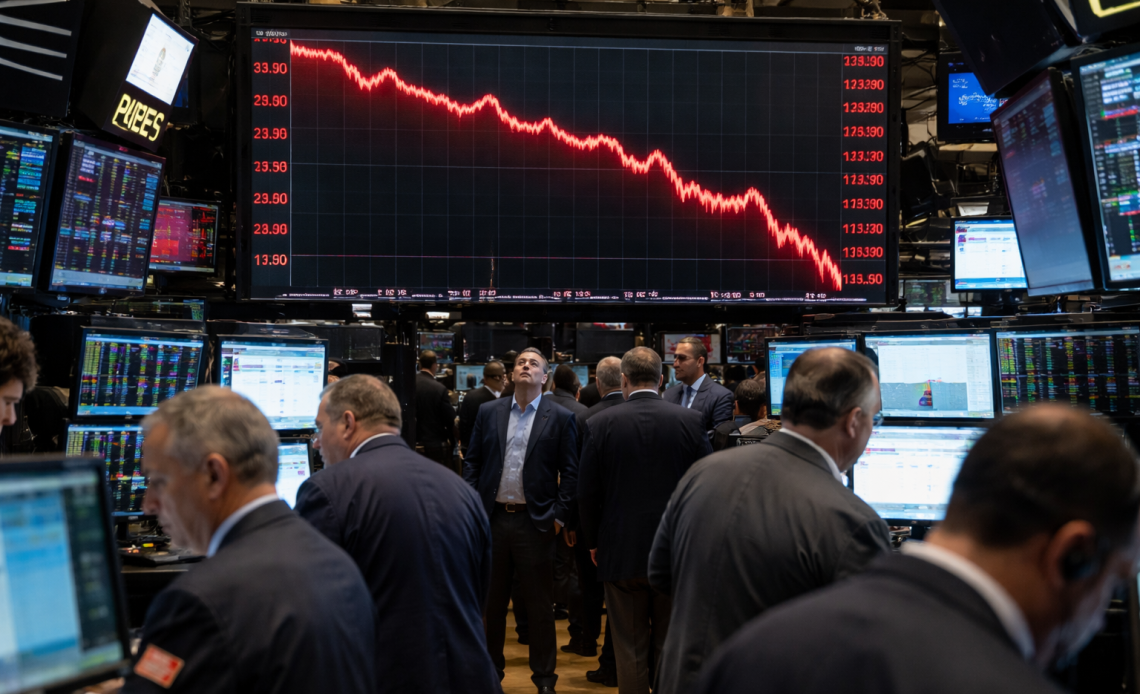
The European stock market saw a decline on Thursday as renewed fears over an escalating US–Iran conflict weighed heavily on investor sentiment.
Fresh comments from Donald Trump about the potential duration of the war triggered a wave of caution across global financial markets.
The pan-European STOXX Europe 600 declined about 1.1% shortly after 9:30 am in London, with most sectors and major regional markets trading in negative territory.
The drop reflects growing investor anxiety about geopolitical risks and their potential impact on global economic stability.
Major European indices trade lower
Several key European stock indices recorded notable losses during early trading.
France’s CAC 40 slipped 0.70% to 7,925.02, while Italy’s FTSE MIB fell 0.98% to 45,266.25.
Germany’s DAX experienced the steepest decline among major indices, dropping 1.46% to 22,959.42.
Spain’s IBEX 35 also declined by 1.06% to 17,394.00.
The United Kingdom’s FTSE 100 showed early volatility, opening in positive territory before slipping into the red, trading down around 0.2% near the 10,343.56 level.
Technology stocks faced the sharpest sell-off.
The STOXX Europe Technology Index dropped around 2.8%, putting the sector on track for its worst trading session since early February.
Trump signals prolonged conflict
Market volatility intensified following remarks from President Donald Trump during a televised address to the American public on Wednesday evening.
Trump indicated that the conflict could last another two to three weeks, stating that US forces would strike Iran “extremely hard” during that period.
His comments quickly affected global markets. US stock futures turned sharply lower as the speech concluded, reversing gains seen during Wednesday’s regular trading session on Wall Street.
Futures data on Thursday morning suggested a weaker opening for US equities.
Asian markets also erased earlier gains as investors reacted to the latest geopolitical developments and reassessed potential economic risks.
Oil prices surge amid Middle East tensions
Energy markets responded strongly to the escalating conflict. Global benchmark Brent crude surged more than 6%, reaching $107.98 per barrel.
Oil prices have risen sharply since the United States and Israel launched military strikes on Iran on February 28.
Iran responded with retaliatory attacks across the Gulf region, heightening tensions and disrupting energy markets.
During March, Brent crude recorded a dramatic rise of more than 60%, marking the largest monthly increase since oil price records began in the 1980s.
Corporate and industry developments
According to reports from Reuters, energy giant Shell is in discussions with the Venezuelan government to develop four major offshore natural gas projects.
Meanwhile, Ryanair CEO Michael O’Leary warned that the United Kingdom could face significant jet fuel shortages if the Iran conflict continues.
The airline chief highlighted the country’s heavy reliance on fuel supplies from Kuwait, making it particularly vulnerable to disruptions.
Investors are also monitoring reports that the Trump administration may introduce new tariffs on pharmaceutical companies that have not agreed to lower drug prices in the United States, adding another layer of uncertainty to global markets.
The post STOXX 600, CAC 40 slide as Trump warns Iran war could drag for weeks appeared first on Invezz